In the intensely competitive world of contemporary professional sliding, podium finishes is no longer exclusively a function of brute torque or driver courage. Conversely, it has evolved into a intricate engineering challenge which demands a meticulous blend of choosing a time-tested car, arming it with the correct performance parts, and, most essentially, understanding its real-time characteristics on the track through advanced suspension tuning applications. This exhaustive guide acts as your master plan starting from the very first idea of a competition vehicle all the way to the final engineering-refined tweaks that transform a powerful car into a predictable champion. We will examine in detail the art and science of vehicle alignment optimization, showing how a advanced drift tuning app like GripDial eliminates assumptions and delivers unmatched visibility into your car's actual behavior.
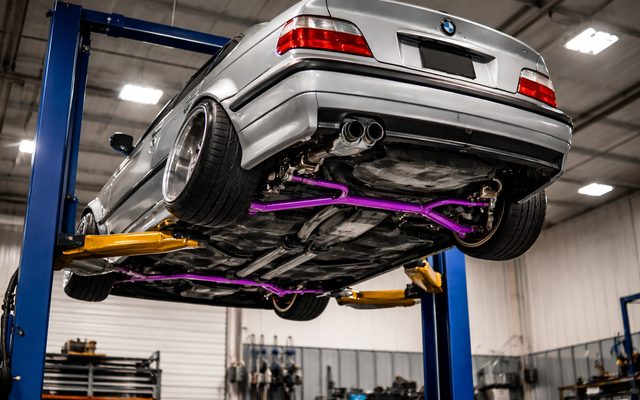
The cornerstone of any exceptional drift machine is, indisputably, the base vehicle itself. Several vehicles have earned legendary status within the global drifting culture due to their built-in handling characteristics, durable design, and the immense range of performance parts available. Selecting the right platform is the primary and most important selection a enthusiast will make. As an example, the BMW's E36 3 Series is widely regarded as one of the greatest balanced cars for drifting of history. Its almost ideal evenly distributed mass, combined with a RWD layout and robust six-cylinder powerplants, creates a chassis that is at once accessible for beginners and incredibly effective in the control of a professional competitor. The successor of this lineage, the BMW E46 platform, refines these qualities with a even more developed structure, broader wheel track for improved high-speed stability, and still increased steering angle as standard from the OEM. A distinct dominant option in the pro circuit is the C6 generation Corvette.
This V8-powered sports car brings a particular combination of strengths to the sliding discipline, including a lightweight alloy structure, a transaxle-style gearbox and differential unit that contributes to an excellent weight distribution, and the immense thrust of a big LS V8 motor. This combination transforms it into an utter monster on track, capable of entering and holding long angles with apparently effortless deployment of power. For those desiring outstanding value, the Nissan Z33 rises above as a prime candidate. It is delivered from the factory with a stiff body structure, a competent original LSD, and the smooth VQ series engine that delivers ample performance for mastering and progressing in the activity. Its successor, the 370Z model, offers additional refinements in structural rigidity, steering geometry, and peak engine power, cementing its position as a common choice among professional competitors. Additional legendary cars that warrant mention encompass the lightweight Wankel-engined Mazda FC, the ubiquitous Nissan S13 240SX, the American Ford SN95, the more recent BMW E90, and the compact yet surprisingly fun and forgiving MX-5 Miata. Each of these chassis provides a unique array of characteristics, complexities, and capabilities, but they all possess the core ingredients essential to be transformed into a serious drift machine.
However, selecting the correct chassis is just the beginning. To access the complete performance of every of these cars, substantial modifications to the steering and suspension systems are completely mandatory. This is where the world of performance aftermarket parts comes into vital view. The most most transformative upgrade for a dedicated drift car is the installation of a maximum-angle steering angle kit. These sophisticated systems, such as those developed by performance brands like SLR Speed, are created to dramatically enhance the vehicle's available turning lock. A factory road car is highly constrained in how far its steering tires can rotate, a design compromise for on-road use. In sliding, conversely, maximum opposite lock is constantly required to catch and sustain a slide. An angle kit replaces the factory uprights, tie rods, and sometimes A-arms with pieces that enable the front tires to reach degrees of turn in excess of 70 or even 80 °, as opposed to a normal factory angle of around 40 to 50 degrees.
This tremendously expanded capability offers the pilot with dramatically enhanced authority during a angle, making it far more straightforward to begin a drift, maintain it through a long bend, and change seamlessly from one direction to another. The improvement in controllability is absolutely transformative. Coupled with a appropriately chosen angle kit is the every bit as essential upgrade to the chassis's spring and damper setup. Store-bought or even expensive road adjustable suspension are just not engineered for the unique and brutal demands of competitive oversteer. A drift-spec system of suspension units is crucial. These specific coilovers feature unique piston tuning and spring strength that are tuned for the violent weight transfer that is typical of aggressive driving. When a pilot starts a drift, the chassis's inertia is transferred rapidly to the outside of the bend. Correct competition dampers control this movement in a consistent way, enabling the car to stabilize promptly and providing the pilot precise feel through the wheel and driver's seat. They additionally allow for precise adjustment of ride height, damping rate, and weight balance, which are all integral aspects of dialing in the car's handling to a particular track or competition style. As a system, a precision-engineered drift angle kit and a expertly selected set of performance coilovers are the core mechanical cornerstone upon which all subsequent refinement is based.
Once the fundamental parts is in place, the following essential phase in the development is the meticulous tuning of the car's alignment. This is the realm of chassis dynamics adjustment, a methodology that can seem intimidating to the beginner but is, in reality, the key to transforming a collection of high-performance parts into a harmonious and controllable whole. The most discussed element of tuning for oversteer is definitely camber. Camber is the angle of the wheel relative to the vertical plane when observed from the front-on of the car. When the upper part of the wheel is tilted towards the chassis, this is known as camber-in. For oversteer driving, inward-leaning wheels on the front axle wheels is widely used and is regarded as essential. The purpose is intrinsically related to tire contact.
When a car is cornering at extreme sideways angles, the chassis rolls to the outer of the turn. This lean makes the outside front wheel to lose its best footprint with the tarmac. By applying inward lean, the wheel is pre-angled to compensate for this roll. As the chassis rolls into the turn, the tire flattens out with the asphalt, increasing its grip at the precise point when it is most required for steering authority. Typically, front axle adjustments for a serious drift machine range from approximately -3 degrees to as high as -5 degrees or even greater, depending on the parameters of the car configuration, tire type, and pilot style. The rear wheels also employ inward lean, but the values are usually more modest and more nuanced than the front. Excessive negative camber at the back can result in the chassis extremely tail-happy and challenging to control on power input, as it reduces the effective grip area of the driven tires during forward power delivery. Therefore, rear axle angles are frequently in the range of -1 degree to -3 degrees, achieving a precise compromise between providing sufficient cornering bite to aid in starting and sustaining the slide while simultaneously preserving usable traction for acceleration the corner. camber angle is merely one part of the more complex alignment equation, which also encompasses toe setting, caster angle, and suspension-induced steering adjustment.
Toe setting refers to the direction of the tires when viewed from the top. Positive toe means the front edges of the wheels are nearer together than the trailing edges, while negative toe means the converse. For oversteer, a modest amount of front axle negative toe is commonly run to improve the initial steering response, making the car feel more agile and eager to initiate a slide. Rear axle toe angle is generally set to zero or a very slight amount of toe-in to promote stability under acceleration. self-centering is the longitudinal or aft inclination of the suspension pivot when looked at from the side-on of the car. Positive caster increases self-centering and stability solidity, and it additionally boosts negative camber gain during steering, which is extremely advantageous. Tuning these parameters is a complex dance where a modification to one setting can and will affect the remaining parameters. The conventional approach for dialing in a car's suspension geometry for sliding has long been a tedious endeavor of guesswork and adjustment. A pilot or team would introduce a adjustment based on experience, run the vehicle on track, rely on the operator's personal feel and impressions, and then apply another tweak. This loop would repeat time after time until the car felt "acceptable" or the allotted track period was exhausted. This methodology is not only incredibly wasteful in terms of hours and tires, fuel, and parts, but it is furthermore deeply imprecise.
Pilot perception is a notoriously inconsistent data source, colored by countless elements such as fatigue, evolving track conditions, weather, and simply the mindset of the driver on that specific day. What feels "oversteery" on one lap might feel "understeery" on the subsequent run, causing conflicting data and ineffective tweaks. This age-old problem in car suspension tuning is exactly where state-of-the-art engineering tools has made its mark to revolutionize the methodology.
The advent and adoption of specialized vehicle dynamics tools has introduced a new age for tuning and optimizing high-performance sliding vehicles. This new generation of systems, represented by cutting-edge systems like car alignment tuning modern telemetry hardware, work by actively measuring the live mechanical performance of the vehicle as it is piloted on the track. Unlike using subjective impression, these systems gather objective information on critical factors such as shock absorber movement, individual tire rotation, G-force loading, wheel angle, and accelerator and brake pedal application. This raw telemetry is then interpreted by powerful algorithms that can graph and analyze the information in a clear way. For the first time, engineers and builders can see precisely what the chassis is doing at each millisecond of a slide. This function transforms the whole suspension tuning workflow. Think about the aforementioned goal of optimizing the front negative camber for a specific car. As an alternative to applying a modification from -3 degrees to -3.5 degrees and then testing many runs to try and "perceive" a difference, a telemetry system can give immediate and irrefutable data. The application can display visually how the wheel's grip is performing during the most important moments of a angle: turn-in, mid-corner, and changing direction. It can demonstrate if the current value is permitting the loaded tire to achieve ideal grip or if the compound is working inefficiently on its outer shoulder.
The tool can then suggest fact-based suggestions for adjustment. Perhaps the telemetry shows that the outside front tire is even stressing its edge at -3.5 degrees of camber, implying that a move towards inward lean, say -4 degrees, might be beneficial. Conversely, the information might indicate that the tire is failing to reaching optimal operating temp or that the inner edge is wearing excessively, which could point to that there is excessive negative camber and a modest lessening back to -3.2 degrees would be better optimal. This standard of accuracy and actionable analysis was literally unimaginable in the time of solely mechanical adjustment.
The effect of utilizing a dedicated suspension tuning tool extends far beyond merely setting camber angles. It becomes an essential suspension tuning guide that is tailored to your specific car. When fine-tuning the damping clickers on your coilovers, rather than relying on general advice or replicating another driver's settings, you can use the data to see how the car is behaving in relation to your tweaks. The software can graph the suspension travel data over a lap, showing if the coilovers are managing the chassis motion effectively or if they are causing the car to oscillate uncontrollably after a transition. It can assist in diagnosing problems like bottoming out or losing droop, permitting you to make educated adjustments to spring preload, drift telemetry software rebound/compression values, or ride height. This methodology extends equally to the complex process of corner balancing. Beyond camber, the tool can offer insight into how changes to toe settings and caster angle are influencing the vehicle's balance during various parts of suspension tuning tool a lap. For example, it can assist you to ascertain the best amount of front axle negative toe for your specific steering rack configuration and competition approach by measuring the speed of initial response and the consistency of the car at lock steering angle. This makes the tool an extremely powerful drift suspension tuning guide that is constantly calibrated by the live performance of your own chassis on the track. It elevates the complete project from a dark art into a repeatable development process.
Additionally, the application of a tool like GripDial is not restricted to expert teams with extensive resources. For the club-level driver, it acts as an incredible educational tool. It in essence gives the driver with the insight of a expert suspension specialist without requiring the corresponding cost. It accelerates the tuning process by giving clear answers to challenges that would traditionally take seasons of experimentation to answer. A driver can see how their particular car reacts to different inputs, gaining a more profound comprehension of vehicle dynamics in the process. It furthermore makes accessible advanced suspension engineering concepts, permitting anyone with the ambition to optimize their car to accomplish it in a efficient and productive manner. This is notably valuable in a sport like oversteer competition, where tuning knowledge has historically been a highly secretive asset among top crews. Now, that power can be in the garage of any motivated driver.
In the final analysis, the path to building and optimizing the perfect competitive drift machine is a multi-stage mission that perfectly combines time-honored engineering wisdom with cutting-edge data technology. It starts with the strategic choice of a proven platform, followed by the integration of critical drift-spec components like high-performance drift angle kits and correctly valved performance coilovers. The build then advances into the intricate stage of alignment optimization, where values like camber angle, toe setting, and caster are carefully configured to match the chassis's new geometry and the operator's specific technique. The final step, and what truly distinguishes the today's approach from the old ways, is the use of a powerful vehicle dynamics tool. This platform eradicates the guesswork and waste of only subjective tuning by delivering empirical, actual data on how the car is truly functioning. It acts as an incredible diagnostic aid, a actionable drift suspension tuning guide, and a master performance analyzer. As a complete package, this complete methodology ensures that every element of the drift machine—from the choice of the car to the most minute click on the damper—is optimized for peak competitiveness on the circuit. It signifies the total progression of the art of oversteer driving, connecting mechanical pilot talent with precise suspension engineering to create the most effective machines possible.